

How Professionals Restore Homes After Wind-Driven Rain Intrusion
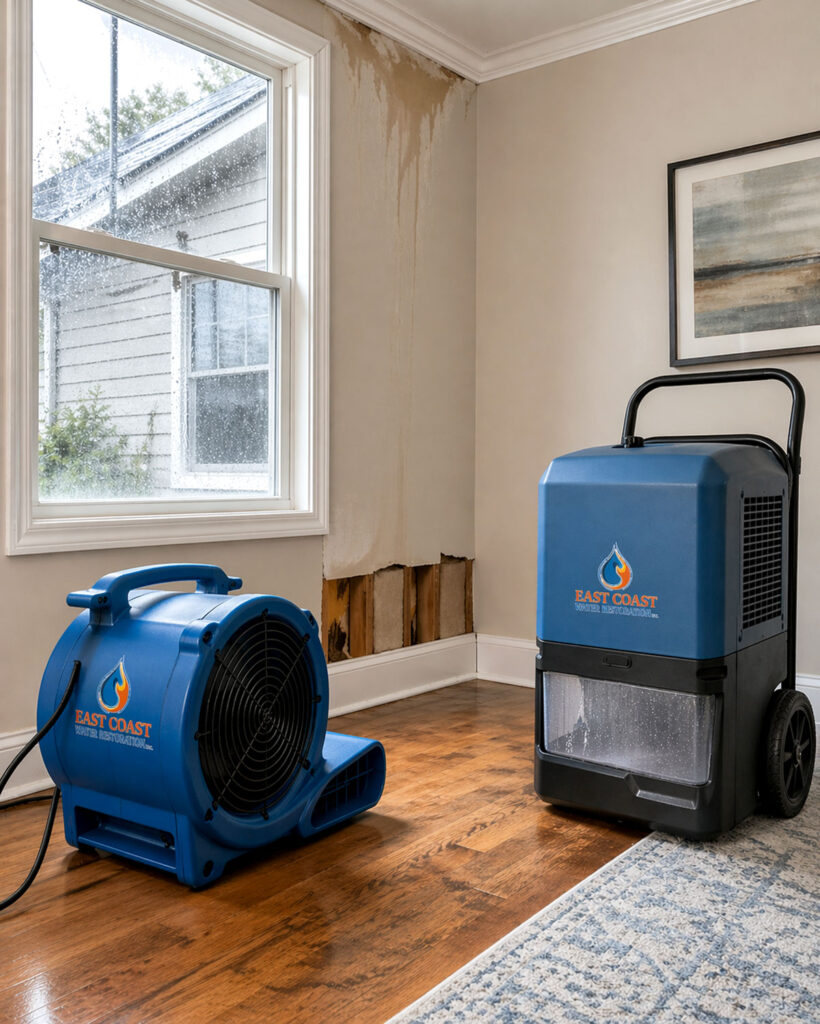
Why Selective Demolition and Structural Airflow are Vital for Recovery
Most people associate storm damage with the dramatic: a tree through a roof, windows blown out, siding peeled away. But in Florida, one of the most common and quietly destructive forms of storm damage doesn’t look dramatic at all. Wind-driven rain works its way into a home through gaps so small you could miss them on a calm day, and once it’s inside, the clock starts ticking.
Why Wind-Driven Rain Is Different
Under normal conditions, rain falls at an angle that most homes are built to handle. But when wind speeds climb during a tropical storm or hurricane, rain gets pushed horizontally with enough force to penetrate window frames, door thresholds, soffits, and the tiny gaps where siding meets trim. No obvious structural failure required. The water is simply driven in by pressure, and it follows the path of least resistance into wall cavities, insulation, and flooring.
That’s what makes it tricky. There may be no broken glass, no visible hole in the roof, no dramatic evidence of entry. Just moisture, accumulating out of sight.
Step One: Finding Where It Got In
The first thing a professional restoration team does is trace the water back to its source. This means a systematic inspection of window frames and seals, door thresholds and weatherstripping, roof edges and soffits, siding joints, and any penetrations in the building envelope like vents or electrical conduits. Identifying the entry points matters not just for restoration, but for making sure the same thing doesn’t happen again.
Removing What Can’t Be Saved
Once the extent of moisture intrusion is understood, wet materials have to come out. Saturated drywall, baseboards, insulation, and flooring can’t simply be dried in place. They hold moisture against structural components and create ideal conditions for mold growth within 24 to 48 hours. Removing them quickly is one of the most important decisions in the restoration process, and experienced crews know how to do it in a way that contains the affected area and protects the rest of the home.
Drying the Structure — Not Just the Surface
This is where professional restoration differs most from what a homeowner might attempt on their own. Pointing a box fan at a wet wall moves air across the surface, but it doesn’t address what’s happening inside the wall cavity. Restoration professionals use commercial-grade air movers positioned to create airflow patterns that draw moisture out of building materials at a structural level, paired with industrial dehumidifiers that remove that moisture from the air before it can resettle elsewhere.
Moisture meters and thermal imaging track progress throughout the process, verifying that drying is reaching the areas that matter, not just the ones you can see.
Mold Prevention and Final Restoration
Once materials have been removed and the structure is dry, antimicrobial treatments are applied to inhibit mold growth before rebuilding begins. From there, the restoration team works to return the home to its pre-loss condition — replacing drywall, reinstalling flooring, repainting, and making the space whole again.
Wind-driven rain demands a fast response. The longer moisture sits, the deeper it penetrates and the more it costs to fix. At East Coast, our teams are equipped to move quickly because in Florida storm recovery, timing is everything.

Navigation
CONTACTS
- Address:
- 2844 Stirling Rd Suite S, Hollywood. FL 33020
© Copyrights 2026 Eastcoastrestorationpros.com | All Rights Reserved | Terms & Privacy