

The Science Behind Structural Drying After Water Damage
Understanding Evaporation, Dehumidification, and the Physics of Effective Moisture Removal
When water gets into a home — from a burst pipe, a storm, an appliance failure, or any other source — the visible cleanup is really just the beginning. The work that prevents long-term damage happens at a level you can’t always see, and it follows principles that are genuinely scientific. Understanding that process helps homeowners know what to expect and why professional structural drying isn’t something that can be shortcut.
It Starts With Evaporation
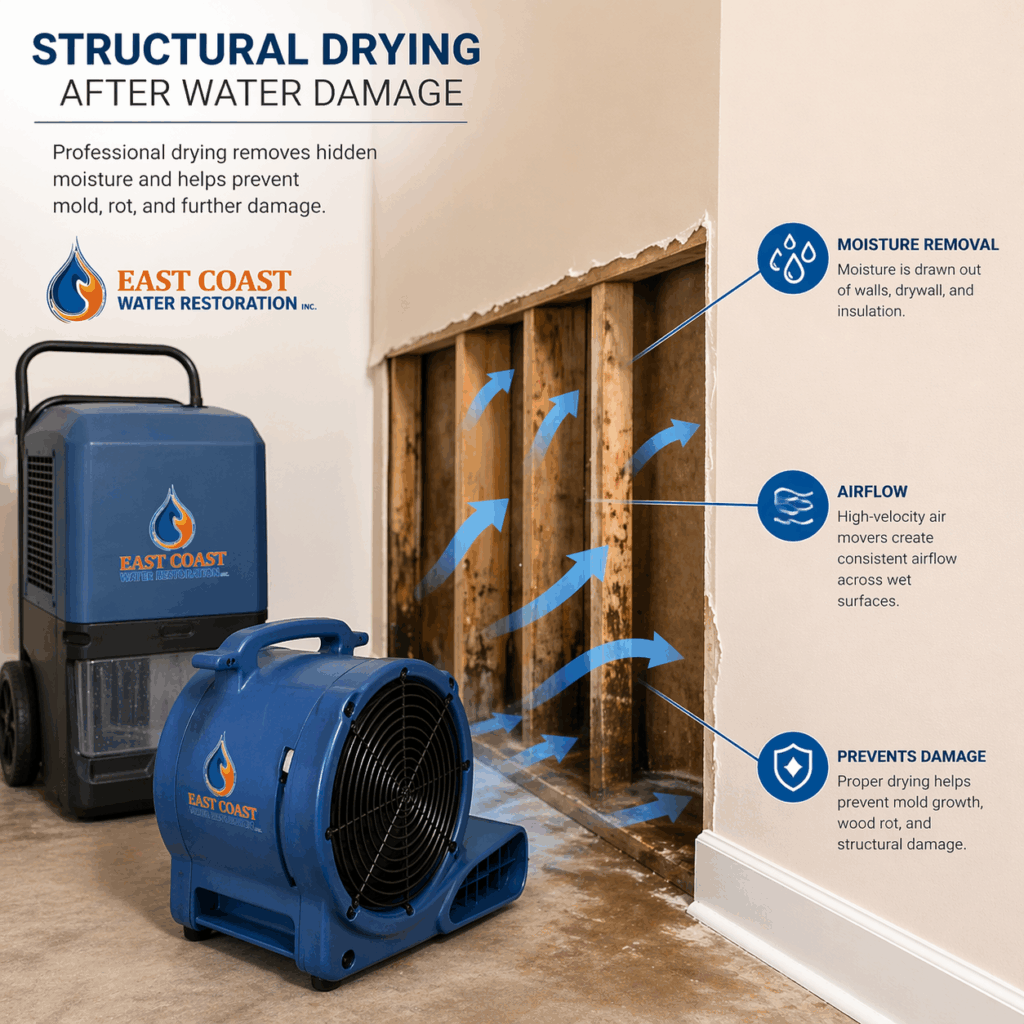
The first goal in structural drying is to move moisture out of saturated building materials and into the surrounding air. Commercial air movers accomplish this by creating high-velocity airflow across wet surfaces, which accelerates the rate at which moisture evaporates. The positioning and quantity of those air movers matters significantly. A skilled technician reads the affected area and sets up equipment in a pattern that maximizes airflow through wall cavities, under flooring, and across other materials that hold water.
Simply blowing air around a room isn’t the same thing, and the difference shows up weeks later in the form of mold or warping.
Then Dehumidification Captures What Evaporation Releases
Here’s the part that’s easy to miss: evaporating moisture from building materials doesn’t make it disappear. It transfers that moisture into the air inside the structure. Without dehumidification, that humid air will eventually resettle into other materials and spread the damage to areas that weren’t originally affected.
Industrial dehumidifiers pull that moisture out of the air continuously, maintaining conditions that keep the drying process moving in the right direction. The combination of air movers and dehumidifiers working together is what makes professional structural drying effective.
Temperature Plays a Role Too
Warmer air holds more moisture and accelerates evaporation from building materials, which is why temperature management is part of a professional drying plan. Technicians take ambient conditions into account and may adjust heating or cooling to support the process. That said, too much heat can cause its own problems — warping wood, accelerating mold growth in pockets of warm humidity, or damaging finishes — so it’s a balance that requires monitoring rather than a simple formula.
Monitoring Is Continuous, Not a One-Time Check
Throughout the drying process, technicians track several data points including:
- Humidity levels in the air throughout the affected space
- Moisture content readings from walls, floors, and ceilings
- Drying progress compared to established benchmarks
This isn’t just documentation for documentation’s sake. The readings drive decisions about when to adjust equipment, when to remove materials that aren’t responding to drying, and ultimately when the job is actually complete.
Drying Is Done When the Numbers Say So
One of the most important things professional structural drying establishes is a clear endpoint. Materials need to return to moisture levels appropriate for the environment before any rebuilding begins. Closing up walls over materials that are still elevated in moisture content — even slightly — creates conditions where mold can develop out of sight for weeks or months before anyone notices.
At East Coast, we document moisture readings throughout the process and don’t consider a structure dry until the numbers confirm it. The science only works if you see it all the way through.

Navigation
CONTACTS
- Address:
- 2844 Stirling Rd Suite S, Hollywood. FL 33020
© Copyrights 2026 Eastcoastrestorationpros.com | All Rights Reserved | Terms & Privacy