

The Difference Between Mitigation and Restoration
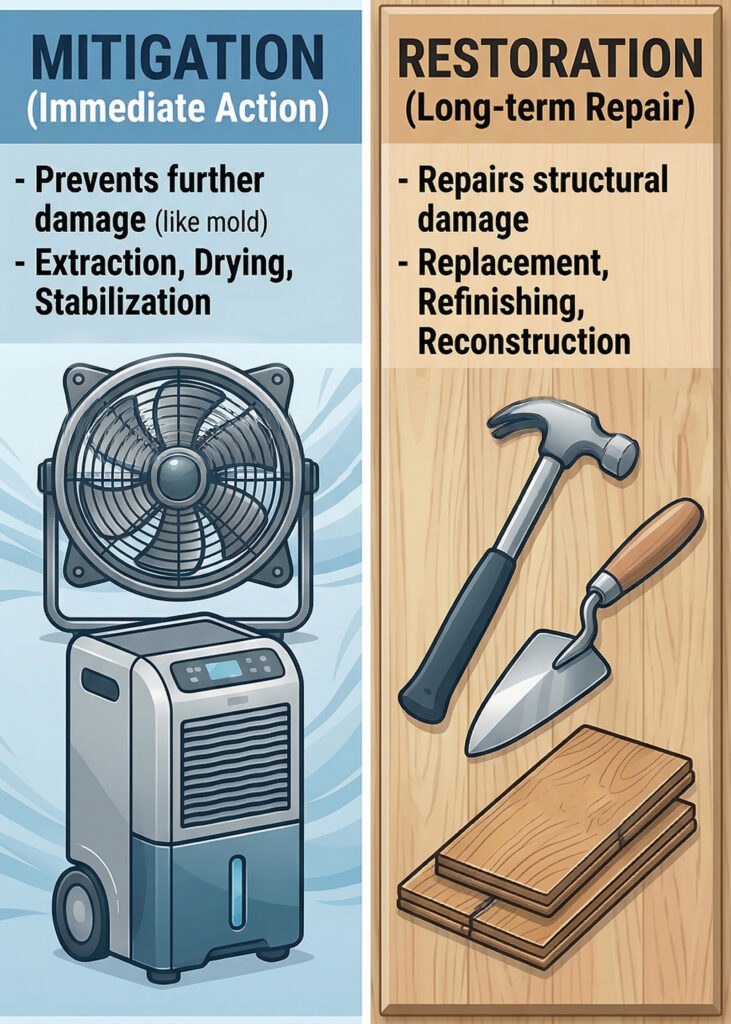
Understanding the Difference Between Immediate Mitigation and Complete Restoration
Water and flooring are a particularly unforgiving combination. What appears on the surface as a stain, a soft spot, or a slight discoloration can represent something considerably more serious beneath — moisture that has moved into the subfloor, compromised the structural layer, or created the conditions for mold to develop where no one can see it.
Professional flooring restoration is not simply about making a floor look right again. It is about ensuring that what is underneath is stable, dry, and sound — because a floor that looks repaired but isn’t fully dried will continue to deteriorate long after the restoration team has left.
Mitigation: the immediate priority
Mitigation is what happens first. Its purpose is not to restore the property — it is to stop the damage from getting worse. When water has entered a structure, every hour it remains increases the scope of what will eventually need to be repaired. Mitigation addresses that urgency directly.
Water extraction, emergency drying, boarding up compromised openings, tarping damaged roof sections, and isolating areas at risk of further deterioration all fall under mitigation. The goal is stabilization — bringing the property to a point where the damage is contained and conditions are no longer actively worsening.
This phase is time-sensitive in a way that restoration is not. The decisions made in the first hours after a loss have a direct bearing on what the restoration phase will ultimately require.
Restoration: returning the property to what it was
Once the property is stabilized, restoration begins. This is the work of bringing everything back — repairing structural damage, replacing materials that couldn’t be salvaged, repainting, reinstalling flooring, and addressing all of the finishing details that return the home to its pre-loss condition.
Restoration is a more measured process than mitigation. It is planned, scheduled, and executed in a sequence that reflects the interdependencies of the work — structural repairs before finishes, drying confirmation before new materials go in, inspections before work is closed out. The goal is not speed for its own sake. It is a complete, durable outcome that holds up over time.
Why the distinction matters for your insurance claim
Insurance policies generally cover both mitigation and restoration, but they are treated as separate line items in the claims process. Mitigation costs — emergency extraction, drying equipment, temporary protective measures — are documented and billed independently from the repair and reconstruction work that follows.
Keeping these phases clearly separated in documentation helps ensure that each is fully accounted for in the claim. Mitigation costs are sometimes overlooked or underrepresented when homeowners are focused on the larger repair scope, but they are legitimate covered expenses that deserve the same attention.
Understanding the distinction also helps homeowners track where their property is in the process — and recognize when one phase should be complete before the next begins.
The value of coordinated communication
Mitigation and restoration involve different scopes of work, and often different teams, working within a timeline that has to align with the insurance company’s review and approval process. When that coordination works well — when the restoration team, the public adjuster, and the insurer are all working from the same documented record and the same timeline — the process moves with far less friction.
When communication breaks down between those parties, timelines slip, costs become disputed, and homeowners are left managing the gap themselves. A restoration team that understands how to work within the claims process, and communicates clearly with all parties involved, removes that burden from the homeowner and keeps the project on track.
Both mitigation and restoration are essential parts of a complete recovery. Neither replaces the other, and neither can be skipped without consequences for the outcome. East Coast Water Restoration handles both phases with the same standard of care — responding quickly when stabilization is the priority, and following through completely when the focus shifts to full restoration.
If your property has been damaged and you’re navigating what comes next, contact our team. We’ll walk you through both phases of the process and make sure nothing gets left out of your recovery.

Navigation
CONTACTS
- Address:
- 2844 Stirling Rd Suite S, Hollywood. FL 33020
© Copyrights 2026 Eastcoastrestorationpros.com | All Rights Reserved | Terms & Privacy